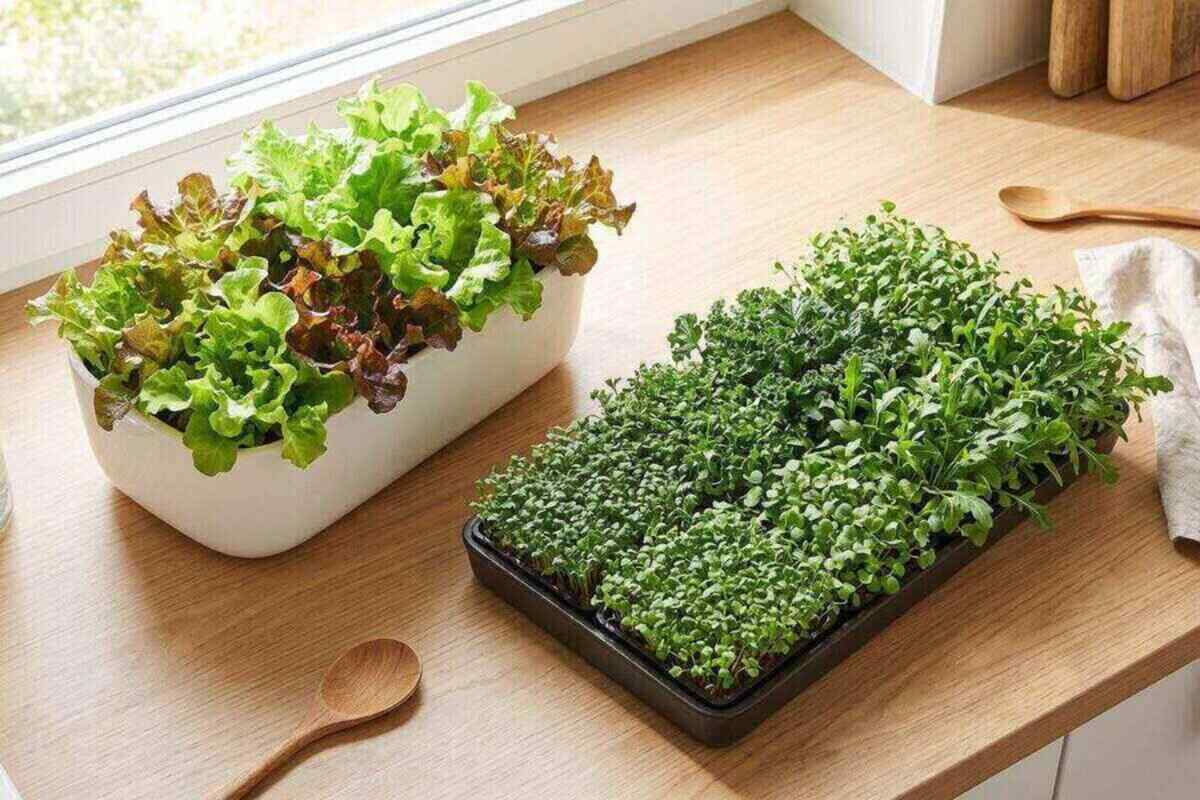
If you're deciding what to grow indoors, the choice between lettuce vs microgreens comes down to one question: do you want a fast harvest or a continuous one? Both are excellent for home growers, but they require different equipment, different effort levels, and deliver very different results. This head-to-head comparison breaks down everything — yield, time to harvest, light needs, and gear — so you can pick the right crop for your setup and start growing today.
Use code WINDOWHARVEST for 10% off all Click & Grow Smart Gardens.
The discount applies automatically through our affiliate links, or enter the code manually at checkout.
The Core Difference: Speed vs Longevity
Microgreens are the sprinters of the indoor garden world. Depending on the variety, you can go from seed to harvest in as little as 7–14 days. They grow in a shallow tray, require minimal equipment, and produce a dense harvest of nutritious shoots — then they're done. You start over with fresh seeds each time.
Lettuce is the long-distance runner. It takes 30–45 days from seeding to first harvest, but once the plant matures, you can harvest outer leaves repeatedly for weeks. A single lettuce plant can keep producing fresh leaves for a month or more if managed well — making it an ongoing supply rather than a one-time yield.
Neither is better in absolute terms. The right choice depends on whether you want quick turnaround or a steady stream of salad greens with less replanting.
Time to Harvest: Microgreens Win on Speed
This is where microgreens have a clear advantage. Common indoor microgreen varieties and their typical harvest windows:
- Radish microgreens: 6–10 days from seeding (one of the fastest available)
- Broccoli microgreens: 8–12 days from seeding
- Sunflower microgreens: 10–14 days from seeding
Lettuce, by contrast, typically reaches the "baby leaf" harvest stage around 25–35 days after seeding, with full-size heads taking 45–60 days depending on variety and growing conditions. Under grow lights with consistent care, loose-leaf varieties like butterhead or romaine can be cut at the baby leaf stage around day 30.
If you want results fast — for a recipe tonight, a garnish this week, or just the satisfaction of a quick win — microgreens are the clear choice. If you're building a long-term kitchen garden where you're harvesting from established plants week after week, lettuce wins.
Yield Comparison: It Depends What You Count
Microgreens produce a dense, single harvest from a tray. A standard 10×20-inch tray can yield anywhere from 4 to 12 ounces of microgreens per grow, depending on the seed variety and density. Radish and sunflower tend to produce heavier yields by weight; broccoli is lighter but highly nutritious.
Lettuce yields differ because you're harvesting repeatedly rather than all at once. A single mature loose-leaf lettuce plant can yield 2–4 ounces per cutting, with multiple cuts available over a 4–8 week harvest window. In a hydroponic system like an AeroGarden, which supports 6 or more plants in a compact countertop unit, your total lettuce output per grow cycle can be substantial.
For raw biomass per square foot of growing space over time, lettuce in a hydroponic setup competes well with microgreens when you factor in the repeated harvest cycles. Microgreens require more frequent seed investment because each tray is a one-time crop.
Light Requirements: Both Need Supplemental Light Indoors
Both crops struggle on a typical windowsill without supplemental lighting. Lettuce requires 12–16 hours of light per day for healthy indoor growth; south-facing windows in winter rarely deliver enough light intensity for vigorous production. Microgreens need slightly less — many growers use 12–14 hours of light daily and do fine — but they still perform significantly better under grow lights than in ambient window light.
The good news: neither crop needs high-intensity lighting. Lettuce and microgreens are both low-light crops compared to fruiting vegetables like tomatoes or peppers. A modest T5 LED strip or a clip-on grow lamp is genuinely sufficient for both.
The Barrina T5 LED Grow Light Strips are a popular choice for both crops — they mount under shelves, cover a standard tray or countertop garden, and provide the full-spectrum light both lettuce and microgreens need at a reasonable price.
→ Check Barrina T5 LED Grow Light Strips on Amazon
For a more flexible option that works for both microgreen trays and small lettuce pots, a gooseneck clip lamp like the GooingTop LED Grow Light lets you position the light exactly where it's needed. It's a good entry-level option if you're just getting started and not yet sure which crop you'll grow more of.
→ Check GooingTop LED Clip Grow Light on Amazon
Equipment: What Each Crop Actually Needs
What You Need to Grow Microgreens
Microgreens are one of the most accessible crops to grow indoors because the equipment requirements are minimal:
- A shallow growing tray (10×20 inch is standard)
- A growing medium — either coconut coir, potting mix, or a hydroponic seed mat
- Seeds suited for microgreen production
- A grow light or bright window
- A spray bottle for watering
You don't need a hydroponic system, pumps, nutrients, or pH testing for basic microgreens. This makes it the lower-barrier option for absolute beginners.
A hydroponic seed mat like the Yuanwovv grows microgreens without soil — seeds germinate directly on the mat, roots grow down through it, and you bottom-water through a tray. It's cleaner than soil, reduces mold risk, and makes harvesting easier since the shoots come off cleanly above the mat level.
→ Check Yuanwovv Hydroponic Seed Mats on Amazon
For seeds, fast-growing varieties like radish and broccoli are excellent starting points. Radish microgreens have a peppery flavor similar to arugula; broccoli is mild and nutritious; sunflower shoots are thick and crunchy — great for sandwiches and bowls.
→ Check Organic Radish Microgreen Seeds on Amazon
→ Check Broccoli Sprout/Microgreen Seeds on Amazon
→ Check Organic Sunflower Microgreen Seeds on Amazon
If you want a more structured growing system — especially for running multiple trays at once — a dedicated sprouter and germination setup makes the process more repeatable.
→ Check Soil-Free Sprouting System on Amazon
What You Need to Grow Lettuce Indoors
Indoor lettuce is slightly more involved because you're supporting a plant through a full growth cycle rather than just germinating shoots. The basic requirements:
- A container or hydroponic system with adequate root space
- Growing medium (potting mix, coco coir, or hydroponic net cups)
- Lettuce seeds or seedlings
- Nutrients (if growing hydroponically)
- A grow light for consistent yields
The easiest path for growing lettuce indoors is a self-contained hydroponic system. The AeroGarden Sprout is a compact 3-pod countertop unit that's ideal for lettuce — it includes a built-in grow light, an automatic timer, and pre-measured liquid nutrients. You plant the seeds, fill the water reservoir, and the system handles the rest. Lettuce pods typically reach harvest size in 3–5 weeks in an AeroGarden.
→ Check AeroGarden Sprout on Amazon
For a larger lettuce garden, the Click & Grow Smart Garden 9 Pro supports 9 plant pods simultaneously. It uses pre-seeded smart soil pods that balance nutrients, pH, and aeration automatically — no measuring or mixing required. Loose-leaf lettuce varieties grow well in Click & Grow systems, and the built-in grow light adjusts intensity automatically over the growth cycle.
→ Check Click & Grow Smart Garden 9 Pro
For growing lettuce in a traditional container setup with supplemental lighting rather than an all-in-one system, quality seeds make a significant difference. Loose-leaf varieties like butterhead, oak leaf, or romaine are best for repeated cut-and-come-again harvests indoors.
→ Check Indoor Lettuce Seeds on Amazon
Beginner vs Experienced Grower: Which Is Easier?
For absolute beginners, microgreens are the more forgiving starting point. The short grow cycle means mistakes don't cost you weeks of effort — if a tray fails because of overwatering or poor airflow, you start over in a week. You learn the basics of seed germination, moisture management, and light quickly, with fast feedback loops.
For beginners who want an all-in-one system with zero guesswork, an AeroGarden or Click & Grow takes most of the management out of lettuce growing. The systems handle nutrients, light cycles, and watering cues, so you're essentially just watching the plants grow.
For experienced growers, microgreens scale well — you can run multiple trays on a tiered shelf with strip lighting and produce a continuous supply by staggering planting dates. Running a new tray every 5–7 days gives you a rolling harvest so you're never without fresh greens. Lettuce also rewards experienced growers who want to optimize variety selection, nutrient ratios, and harvest timing for maximum ongoing yield.
Flavor and Use: What Goes on Your Plate
Microgreens and lettuce serve different culinary roles. Microgreens are intensely flavored — radish shoots are peppery, sunflower is nutty, broccoli is mild. They're used as garnishes, sandwich toppings, smoothie additions, and salad accents. Because they're harvested at the cotyledon or first true leaf stage, the flavor is concentrated. They're not a substitute for lettuce in a salad bowl — they're an addition or accent.
Lettuce provides the bulk of a salad. Butter lettuce, romaine, and loose-leaf varieties grown indoors under good light are noticeably fresher and more flavorful than store-bought — no days of cold-chain storage or plastic packaging involved. If your goal is replacing grocery store salad greens entirely, lettuce is the path.
Many growers run both simultaneously — microgreens for fast flavor accents, lettuce for steady salad supply. They use compatible equipment (the same grow lights work for both) and the two crops complement each other perfectly on a tiered shelf or kitchen windowsill setup.
Cost to Get Started
Microgreens have a lower entry cost. A pack of growing trays, a bag of seeds, and a basic grow light can get you started for under $40–50. The ongoing cost is primarily seeds, which are inexpensive in bulk — a pound of broccoli or radish microgreen seeds costs $10–20 and produces many trays.
Indoor lettuce costs more upfront if you go the all-in-one hydroponic route. AeroGarden Sprout and Click & Grow Smart Garden 3 are the most affordable entry points, and they include everything you need including lighting. If you're buying a standalone container and grow light separately, costs are similar to the microgreen setup.
Both crops have very low ongoing running costs — grow lights use minimal electricity, and seeds are cheap relative to the fresh produce you replace.
The Verdict: Which Should You Grow?
Choose microgreens if: You want the fastest possible harvest, lowest startup cost, minimal equipment, and you're looking for flavor-packed garnishes and salad additions rather than a full salad base.
Choose indoor lettuce if: You want a continuous supply of fresh salad greens, you're willing to wait 4–5 weeks for first harvest, and you prefer harvesting repeatedly from established plants rather than replanting every week.
Grow both if: You have the space. The equipment overlaps significantly — the same grow lights, the same shelf, the same care routines work for both. Running a microgreen tray alongside a small lettuce garden gives you the best of both: immediate harvests while your lettuce matures, then ongoing salad greens plus a constant rotation of fresh shoots. It's the most productive use of a small indoor growing setup.
For more on setting up your indoor garden from scratch, see our guide on hydroponics for beginners and our roundup of the best hydroponic systems for indoor gardening.