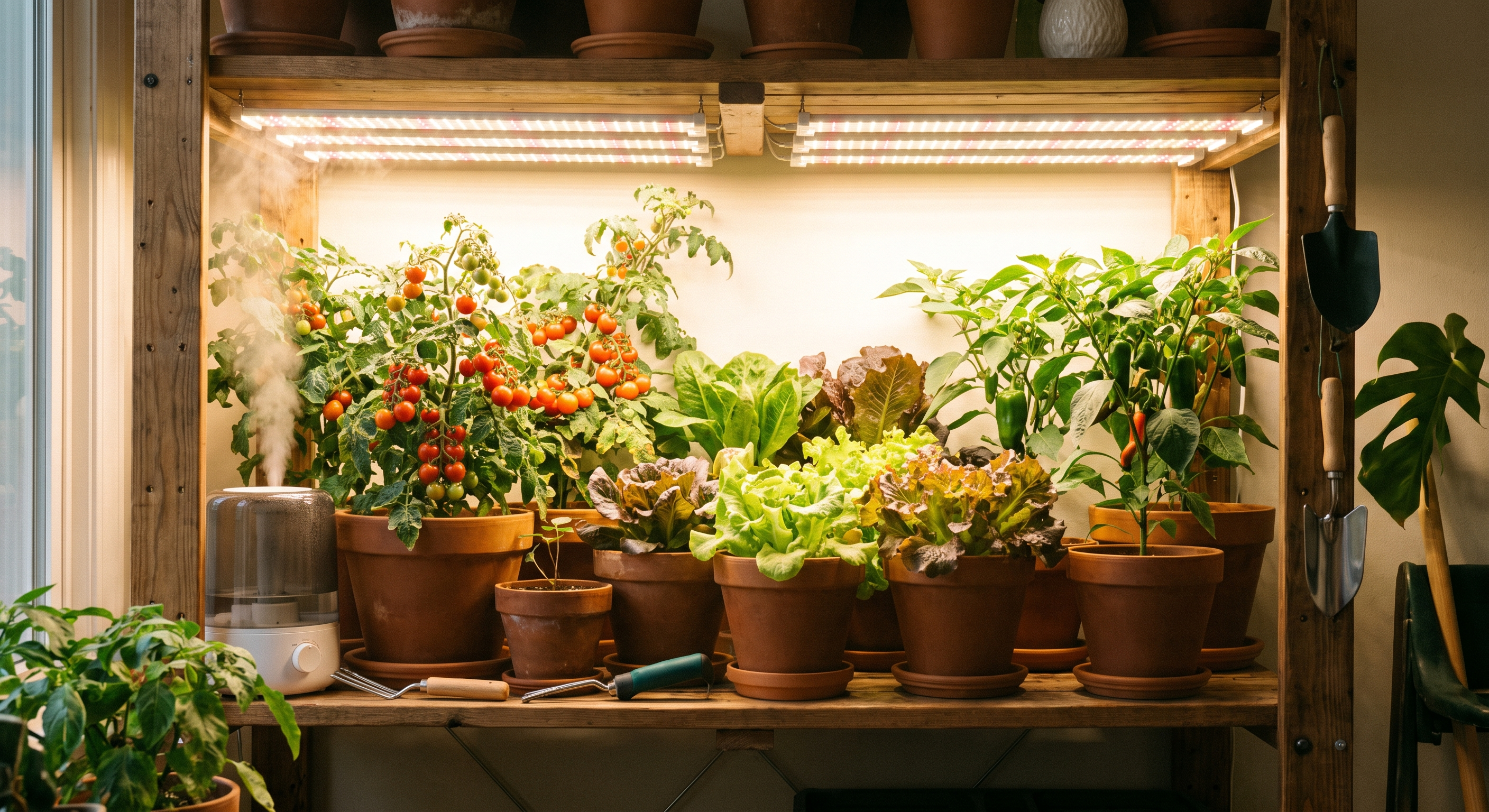
Best Grow Lights for Indoor Vegetables (Under $100)
Growing vegetables indoors demands serious light—far more than herbs or microgreens. Tomatoes, peppers, lettuce, and other vegetables need 12–16 hours of bright light daily to produce fruit, set flowers, and stay healthy. That's where grow lights for vegetables come in. But not all budget grow lights are created equal, and dropping $300+ on a premium fixture isn't necessary if you know what to look for. This guide covers the best affordable grow lights for vegetables under $100, with honest reviews of which ones actually deliver results for home growers.
Use code WINDOWHARVEST for 10% off all Click & Grow Smart Gardens.
The discount applies automatically through our affiliate links, or enter the code manually at checkout.
Why Vegetables Need Different Lighting Than Herbs
Here's the key difference: herbs tolerate lower light levels and will grow under standard fluorescent bulbs. Vegetables—especially fruiting crops like tomatoes, peppers, and eggplants—need higher light intensity and the right spectrum to trigger flowering and fruit set. Without adequate light, you'll get tall, leggy plants with no productivity.
Most vegetables need at least 400–800 µmol/m²/s (micromoles per square meter per second) of light to thrive. That's measured as photosynthetic photon flux density (PPFD), and it's the metric that matters when choosing a grow light. Budget lights often don't publish PPFD specs, which is frustrating—but we'll dig into which budget options actually hit those numbers.
Best Overall Pick: Barrina T5 LED Grow Light Strips
The Barrina T5 LED Grow Light Strips are the best all-around option for growing vegetables on a budget. They come in multiple lengths (2 feet, 4 feet, 6.5 feet), so you can customize your setup to your space. The T5 form factor means they're slimmer and more energy-efficient than older T8 or T12 fluorescents, and the full-spectrum diodes support both veg and flowering stages.
What makes Barrina stand out is value-per-dollar. You get daisy-chain capability (link multiple units together), dimmable controls, and a spectrum designed specifically for plants. Many growers report using two or three Barrina strips stacked vertically to achieve the light intensity needed for peppers and tomatoes. The build quality is solid—no reports of early failures—and they run cool enough that you can position them within 3–6 inches of plant canopies without heat stress.
The downside: T5 LEDs are less efficient than panel-style lights, so you'll use more electricity than premium options. But for under $100, this is the productivity sweet spot.
→ Check Barrina T5 LED Grow Light Strips on Amazon
Budget Pick: GooingTop LED Clip-On Grow Light
If you want the absolute lowest entry point, the GooingTop LED Clip-On Grow Light is hard to beat. At around $25–35, it's cheap enough to buy multiple units without breaking the bank. The clip design lets you attach it to shelving, desks, or plant stands, making it flexible for small spaces or single plants.
The spectrum is tunable—you can dial in a blend for different growth stages—and it comes with three brightness settings. Built-in power adapters (no external brick) keep the desk or shelf clean. Gooseneck design gives you directional control, so you can angle light exactly where it's needed.
The catch: each clip light covers maybe one plant effectively. For a seedling tray or a few pepper plants, this is fine. For a serious vegetable operation, you'd need several units or combine them with other lights. Also, don't expect the PPFD specs to match high-end panels—these are better for supplemental or smaller-scale grows.
→ Check GooingTop LED Clip-On Grow Light on Amazon
Comparison Table: Budget Grow Lights for Vegetables
| Light | Price | Coverage | Best For |
|---|---|---|---|
| Barrina T5 | $45–$95 | 2–6.5 ft | Trays, seedlings, multiple plants |
| GooingTop Clip | $25–$35 | 1–2 plants | Individual plants, small spaces |
| VIPARSPECTRA P700 | $79–$99 | 2 x 2 ft | Flowering, fruiting vegetables |
VIPARSPECTRA P700 LED: Best for Tomatoes & Peppers
The VIPARSPECTRA P700 is a compact LED panel that sits right at the top of the under-$100 budget and delivers performance closer to premium lights than you'd expect. It's designed specifically for the flowering and fruiting stages, with a spectrum that leans toward red wavelengths—perfect for tomatoes, peppers, and other fruiting crops.
Real-world specs: the P700 covers a 2 x 2 foot area effectively, pulling about 90 watts of actual power consumption. The dimmable controller is intuitive, and it supports daisy-chaining multiple units if you want to expand. Many experienced growers report reliable yields of peppers and tomatoes with this light as their primary fixture. The build is heavier than Barrina, suggesting durability.
The trade-off is that it's less versatile for early-stage seedlings (the red-heavy spectrum isn't ideal for veg growth), so it's better as a dedicated flowering light. If you're starting seeds indoors, pair it with cooler-spectrum lights, then switch to this once plants are flowering.
→ Check VIPARSPECTRA P700 LED on Amazon
AeroGarden Sprout: All-in-One for Lettuce & Herbs
The AeroGarden Sprout is technically a hydroponic garden kit, not a standalone grow light, but it's worth mentioning because it includes full-spectrum LED lighting built in. If you want to grow lettuce, leafy greens, and herbs indoors without fussing with separate lights, soil, and nutrients, this is the simplest path.
It's hydroponic, so plants grow directly in water infused with nutrients—no soil needed. The built-in light runs 16 hours daily automatically, and you just add water and swap seed pods every few weeks. It's less about growing large fruiting vegetables (space constraints) and more about fresh greens and herbs year-round.
Pros: completely self-contained, minimal maintenance, and you get harvestable greens within 2–3 weeks. Cons: limited to smaller plants and leafy crops; not suitable for tomatoes or large peppers; seed pods are proprietary and ongoing cost.
→ Check AeroGarden Sprout on Amazon
Optimizing Light for Fruiting Vegetables
Even the best grow light won't deliver fruit without proper spectrum and photoperiod. Here's what works:
Photoperiod (How Long to Run the Light)
Tomatoes and peppers need 14–16 hours of light daily for optimal flowering and fruiting. Lettuce and leafy greens thrive on 12–14 hours. Use a simple timer to automate this—no guesswork needed.
Light Spectrum
Full-spectrum lights work for all stages, but many growers layer their approach:
- Early seedlings: Cool white (5000–6500K) promotes compact, bushy growth
- Flowering & fruiting: Warm red (2700–3000K) combined with white triggers flowering and larger fruit
Distance from Plants
Most LED grows lights should be positioned 12–24 inches above young seedlings, then adjusted as plants grow. Barrina T5s can go closer (3–6 inches) without heat stress. Check your specific light's guidelines to avoid light burn.
Supplemental Nutrients for Indoor Vegetables
Grow lights alone don't feed your plants. When growing hydroponically or in containers, you need good fertilizer. For indoor vegetable gardening, we recommend a balanced liquid formula for early growth, then switch to flowering fertilizer once plants start fruiting.
→ Check General Hydroponics FloraGro Fertilizer on Amazon
For organic growers, fish-based fertilizers work well and smell less intense than they used to:
→ Check Neptune's Harvest Fish & Seaweed on Amazon
Monitoring pH & Humidity
Indoor vegetable gardens need humidity control and pH monitoring. LED grow lights create warm, dry microclimates, which stresses plants. Many growers add a basic humidifier or place a tray of water near the plants to raise humidity to 50–70%.
For hydroponic setups, pH matters: vegetables prefer 6.0–7.0 for soil-based grows, or 5.5–6.5 for hydroponic. A cheap pH test kit prevents nutrient lockout and other problems.
→ Check General Hydroponics pH Kit on Amazon
Related Articles
Want to go deeper? Check out our guides on how to grow tomatoes indoors, how to grow peppers indoors, and our full roundup of the best grow lights for all edible plants.
Final Verdict: Which Grow Light Should You Buy?
Best overall for serious growers: Barrina T5 LED Grow Light Strips. Two or three units stacked will support a serious vegetable operation for under $200 total, and the light quality is proven by years of happy growers.
Best budget pick for one or two plants: GooingTop LED Clip-On. Cheap, flexible, and perfect for testing the waters before investing more.
Best for flowering & fruiting: VIPARSPECTRA P700. If you specifically want peppers or tomatoes to produce heavily, this is the light to pair with seedling lights or full-spectrum supplements.
Best for salad & herbs: AeroGarden Sprout. Forget about individual grow lights and soil—just pop in seed pods and harvest greens every few weeks.
Start with one light and one crop. Learn how your setup responds. Then add or upgrade. Indoor vegetable growing isn't complicated—just follow the basics (light, nutrients, humidity), and you'll have fresh tomatoes and peppers all winter.