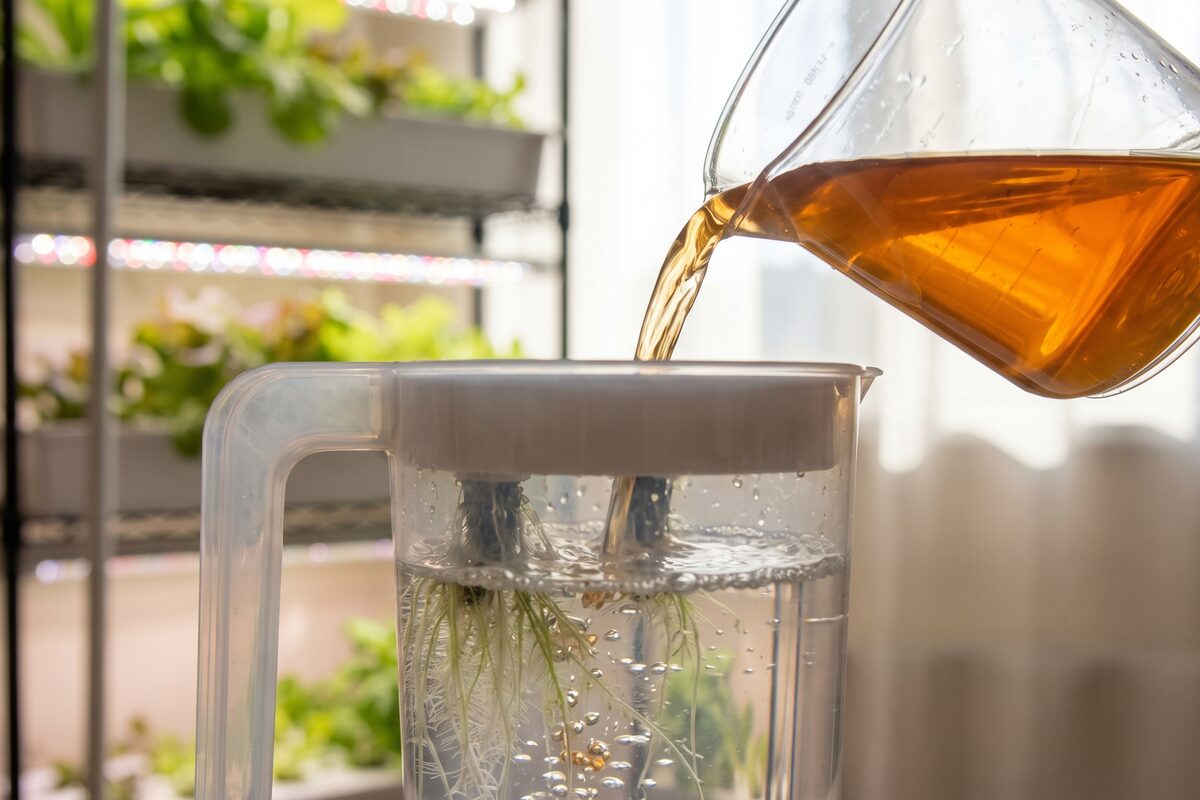
Choosing the right hydroponic fertilizer is the single most important decision you make as an indoor grower. Get it right and your herbs, greens, and vegetables grow fast, taste great, and keep producing. Get it wrong and you end up with deficiency symptoms, stunted plants, and wasted money on nutrients your crops can't even absorb. This guide covers everything you need to know about indoor garden nutrients — NPK ratios, liquid vs powder, organic vs synthetic, and which products actually deliver results for home hydroponic setups.
Why Hydroponic Fertilizer Is Different From Soil Fertilizer
In soil, a complex ecosystem of bacteria, fungi, and organic matter breaks down nutrients and makes them available to plant roots over time. The soil buffers pH fluctuations, holds moisture, and corrects minor deficiencies through microbial activity. In a hydroponic system, none of that exists. Your plants are growing in water, and the only nutrients available are exactly what you put in.
This makes hydroponic fertilizer both more powerful and more demanding than soil fertilizer. The concentration, pH, and balance of your nutrient solution directly controls everything your plants experience. Done correctly, hydroponics lets you dial in growth precisely and produces crops 30–50% faster than soil equivalents. Done poorly, it leads to lockout, toxicity, and plant death faster than any soil problem would.
For herbs and greens in a typical countertop setup — an AeroGarden, a DWC bucket, or a nutrient film system — you need a complete fertilizer that provides all essential macro and micronutrients in a water-soluble form, at a concentration appropriate for the growth stage.
Understanding NPK Ratios for Indoor Hydroponic Gardens
NPK stands for nitrogen (N), phosphorus (P), and potassium (K) — the three primary macronutrients plants need in the largest amounts. On any fertilizer label, you'll see these listed as three numbers separated by dashes, like 3-1-2 or 2-1-6. What those numbers mean in practice:
- Nitrogen (N): Drives leafy green growth. High nitrogen promotes lush foliage — ideal for herbs and leafy greens like lettuce, spinach, and basil during vegetative growth.
- Phosphorus (P): Supports root development and flowering. More important in later growth stages for flowering vegetables and fruiting crops.
- Potassium (K): Regulates overall plant health, water uptake, and disease resistance. Essential throughout all growth stages.
For leafy herbs and greens — the most common crops in indoor hydroponic systems — you want a nitrogen-forward formula during vegetative growth. A ratio like 3-1-2 or 2-1-6 is appropriate for most herbs and lettuces. For fruiting crops like tomatoes and peppers, you'll transition to a more balanced or potassium-forward formula once flowering begins.
Beyond NPK, a complete hydroponic nutrient solution also needs calcium, magnesium, sulfur, and a full suite of micronutrients including iron, manganese, zinc, copper, boron, and molybdenum. A deficiency in any of these — even in tiny amounts — shows up as visible symptoms and reduced yield.
Liquid vs Powder Hydroponic Nutrients
Both formats deliver the same essential nutrients, but they differ in convenience, cost, and stability.
Liquid Nutrients
Liquid concentrates are already dissolved and easy to measure — you simply add the recommended amount to your reservoir. They're more beginner-friendly and mix quickly. The downside is cost: you're paying to ship and store water weight, and bottles run out faster than equivalent powder volumes.
Powder Nutrients
Powder or crystalline nutrients have a longer shelf life, lower cost per gallon of solution, and are lighter to ship. The trade-off is that some require more careful mixing to fully dissolve, and two-part or three-part systems need to be added in the correct order to prevent nutrient binding before they reach your reservoir.
For home growers with small setups, liquid is usually the more practical choice. For larger systems or growers managing multiple reservoirs, powder becomes cost-effective quickly.
Organic vs Synthetic Hydroponic Nutrients
This is one of the most common points of confusion for new hydroponic growers. Here's the honest breakdown:
Synthetic Nutrients
Mineral-based synthetic nutrients are salts derived from mined or chemically processed sources. They are highly water-soluble, pH-stable, and predictable. Plants absorb them immediately with no microbial intermediary required. For most hydroponic setups — especially recirculating systems and systems without a biological filter — synthetic nutrients are the standard choice.
General Hydroponics FloraGro is one of the most widely used synthetic hydroponic nutrients in the world. Its 2-1-6 ratio is designed specifically for vegetative growth stages and works exceptionally well for leafy herbs and greens. It's part of a three-part system (FloraGro, FloraMicro, FloraBloom) that gives you precise control over every growth stage.
→ Check General Hydroponics FloraGro on Amazon
Organic Nutrients
Organic nutrients are derived from plant or animal sources — fish emulsion, kelp, worm castings, bone meal, and similar inputs. In a traditional hydroponic system, they come with challenges: they can cloud your reservoir, clog pumps and drip lines, promote algae growth, and create anaerobic conditions in standing water. They also typically require microbial activity to convert nutrients into plant-available forms — which is hard to maintain in a sterile hydroponic environment.
That said, for wick systems, kratky setups, or semi-hydroponic media-based systems, organic inputs can work well and produce clean-tasting herbs. Neptune's Harvest Fish & Seaweed fertilizer is a popular organic option among growers who want a gentler, naturally-derived nutrient source. It contains both macro and micronutrients in an accessible liquid form and works well at low dilution rates for herbs and greens.
→ Check Neptune's Harvest Fish & Seaweed on Amazon
Best Fertilizers for Indoor Hydroponic Gardens
Best for Vegetative Growth: General Hydroponics FloraGro
FloraGro is the workhorse of the General Hydroponics Flora Series and specifically formulated for the vegetative stage of plant growth. Its 2-1-6 NPK ratio encourages strong root development alongside lush green foliage — exactly what you want from herbs and leafy greens. Used as part of the three-part Flora Series system, it gives you the flexibility to adjust your nutrient profile for every stage from seedling to harvest. It's compatible with all hydroponic systems and is one of the most reliable and tested formulas available to home growers.
→ Check General Hydroponics FloraGro on Amazon
Best Organic Liquid Option: FoxFarm Grow Big
FoxFarm Grow Big is a liquid concentrate designed specifically for the vegetative growth stage. It combines earthworm castings, Norwegian kelp, and other organic inputs with chelated micronutrients to deliver a complete nutrient profile in liquid form. The 3-2-6 NPK ratio is nitrogen-forward for leafy growth while maintaining the potassium level that keeps plants resilient. Many growers use it in media-based hydroponic systems like coco coir or perlite, where the slightly cloudy nature of organic liquids is less of a concern than in open-water recirculating systems.
→ Check FoxFarm Grow Big on Amazon
Best for Supplemental Organic Tea: Botanicare Pure Blend Tea Grow
Botanicare Pure Blend Tea Grow is an organic-based supplement designed for the vegetative growth phase. With a 0.5-0.5-1.0 NPK ratio, it's not a standalone nutrient solution but rather a complement to a base nutrient program — adding organic compounds, humic acids, and trace minerals that purely synthetic formulas don't provide. Many experienced growers use it alongside a mineral base formula to get the best of both approaches: the precision of synthetic nutrients with the biological complexity of organic inputs. Works well in media-based and recirculating hydroponic systems alike.
→ Check Botanicare Pure Blend Tea Grow on Amazon
Best Organic Option for Semi-Hydroponic Setups: Espoma Organic Indoor Plant Food
For indoor growers running semi-hydroponic or wick-based systems with a substrate like coco coir, perlite, or Hydroton, Espoma's Organic Indoor Plant Food delivers a gentle, balanced nutrient profile without synthetic salts. It's derived from feather meal, bone meal, and other natural sources, and it works well for indoor herbs and greens that benefit from a more buffered feeding approach. Use at half the recommended rate in any recirculating system to minimize debris accumulation.
→ Check Espoma Organic Indoor Plant Food on Amazon
Best All-Purpose Organic Supplement: Dr. Earth Pure Gold
Dr. Earth Pure Gold All Purpose fertilizer is a granular organic option best suited for hydroponic setups that use a solid substrate — coco, perlite, or a similar media bed. The slow-release granular format breaks down with watering, providing a steady low-level background nutrient supply that pairs well with a liquid base formula. It's certified organic, non-GMO, and contains a blend of fishbone meal, feather meal, and kelp meal that delivers a broad micronutrient profile beyond what NPK numbers alone convey.
→ Check Dr. Earth Pure Gold on Amazon
Cost Per Harvest: What Does Hydroponic Fertilizer Actually Cost?
One question every home grower eventually asks is whether hydroponic nutrients are actually cost-effective at home scale. The short answer is yes — significantly so.
A quart of General Hydroponics FloraGro typically costs around $15–20 and, at standard mixing rates, makes enough solution for multiple reservoir changes across a full growing season. For a small countertop system producing 3–4 harvests of herbs or greens, your nutrient cost per harvest often works out to $2–5 — less than the price of a single bunch of fresh herbs at a grocery store.
Organic liquid nutrients tend to run slightly higher per-gallon-of-solution than mineral-based formulas, but the gap is modest at home scales. The bigger cost driver in hydroponic growing is electricity (grow lights) and the initial system hardware — not the nutrients.
The Role of pH in Nutrient Absorption
No discussion of hydroponic nutrients is complete without addressing pH. Even the most perfectly balanced nutrient solution becomes useless if your reservoir pH is out of range. At the wrong pH, nutrients precipitate out of solution or exist in forms plant roots cannot absorb — a condition called nutrient lockout. You can be adding nutrients correctly and still see deficiency symptoms if pH isn't managed.
For most herbs and greens in a hydroponic system, a reservoir pH of 5.5–6.5 is the target range. Check your reservoir pH at every water change and any time plants show deficiency symptoms. pH drift — especially upward — is common as plants uptake nutrients and water over time.
A pH test and adjustment kit is not optional equipment. It's as essential as the nutrients themselves. The General Hydroponics pH Control Kit includes both a test solution and pH Up/Down adjusters in a single package — everything you need to maintain proper pH without buying multiple products separately.
→ Check General Hydroponics pH Control Kit on Amazon
All-in-One Solution: Click & Grow Smart Garden 9 Pro
If you'd rather skip nutrient mixing entirely, the Click & Grow Smart Garden 9 Pro is worth considering. It uses pre-nutrient-loaded smart soil pods that take fertilizing completely off your task list — no measuring, no pH monitoring, no mixing. You fill the water reservoir, insert a plant pod, and the system handles the rest. The 9 Pro supports nine pods simultaneously, comes with a high-quality built-in LED grow light, and is available in herb, vegetable, and flower varieties. The trade-off is that you're committed to Click & Grow's pod ecosystem, which costs more per harvest than managing your own nutrients. For growers who want simplicity above all else, that's an easy trade.
→ Shop Click & Grow Smart Garden 9 Pro
Organic Soil Amendments for Media-Based Hydroponic Systems
For growers using coco coir, perlite, or similar media beds, adding worm castings to your substrate is one of the most effective low-tech ways to build a biological buffer into your growing media. Worm castings improve substrate structure, add beneficial microbes, and provide a slow-release nutrient background that smooths out the peaks and valleys of liquid nutrient feeding.
BRUT Worm Castings are 100% organic, odorless, and can be mixed directly into coco or perlite at 10–20% by volume before planting. Unlike raw compost, they won't burn roots and won't introduce weed seeds or pathogens. Many growers use them as a root zone amendment in every media-based indoor grow.
→ Check BRUT Worm Castings on Amazon
Granular Options: Jobe's Organics All-Purpose
Jobe's Organics All-Purpose Granular fertilizer is another slow-release organic option for media-based setups. It uses Jobe's proprietary Biozome microorganism blend — a mix of mycorrhizal fungi and bacteria — alongside a 4-4-4 NPK profile. In a coco or soil-substitute media, it breaks down gradually with each watering, providing a consistent low-level feed that reduces how often you need to apply liquid nutrients. It's particularly useful at transplanting time, when you want to establish a root zone nutrient base before switching to a full liquid nutrient program.
→ Check Jobe's Organics All-Purpose Granular on Amazon
Final Verdict
For most indoor hydroponic growers running recirculating systems with herbs, greens, and vegetables, General Hydroponics FloraGro paired with the full Flora Series is the most reliable and cost-effective choice. If you prefer organic inputs and run a media-based system, Neptune's Harvest or FoxFarm Grow Big provide solid results with a more natural nutrient profile.
Regardless of which fertilizer you choose, a pH test and adjustment kit is non-negotiable — it's the one tool that makes every other nutrient decision actually work. And if you want to skip nutrient management entirely, the Click & Grow Smart Garden 9 Pro delivers genuine harvests with none of the chemistry.
For more on setting up your indoor growing space, see our beginner's guide to hydroponics and our roundup of the best hydroponic systems for indoor gardening.