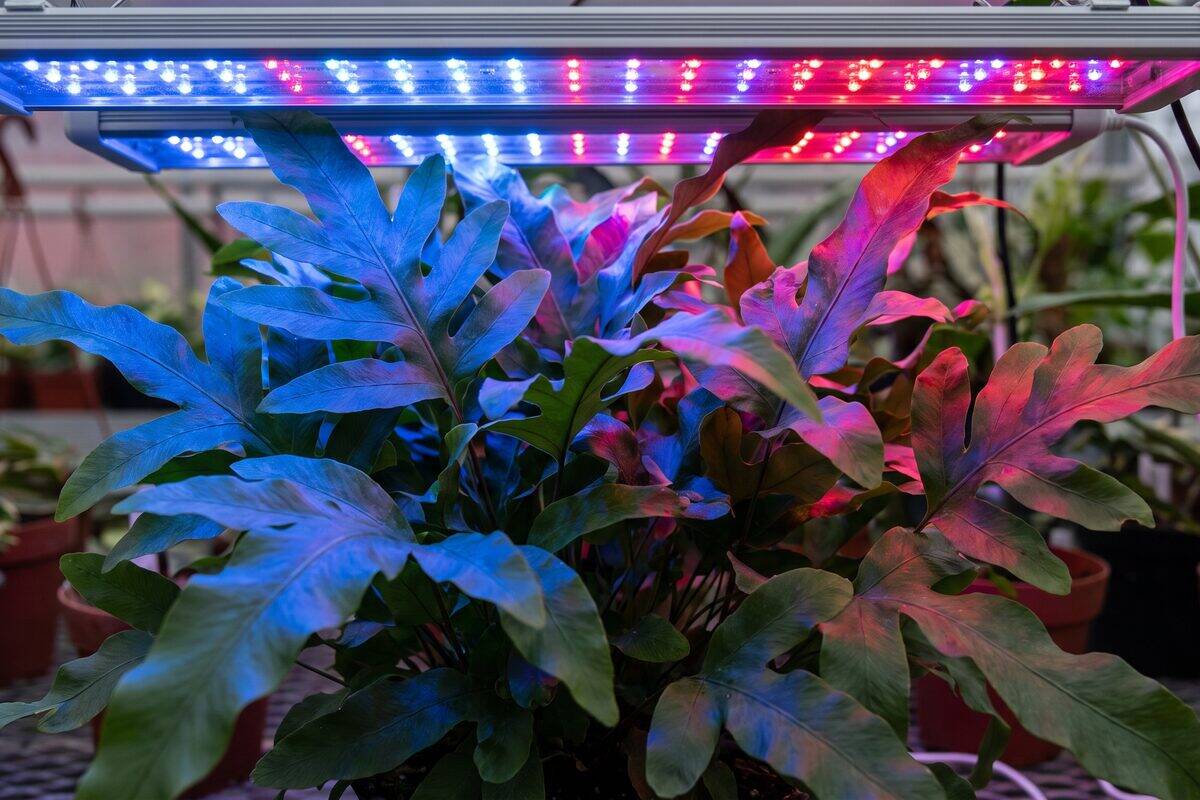
If you've ever wondered why your herbs are lush and leafy but never seem to flower, or why your flowering plants look spindly instead of bushy, the answer might be hiding in your light spectrum. Grow light spectrum — the color of light your plants receive — is one of the most underrated factors in indoor gardening. Blue light drives vegetative growth. Red light triggers flowering. And knowing when to use each can transform your results from frustrating to flourishing.
This guide breaks down grow light spectrum in plain terms: what the science actually says, how to apply it at home, and which lights give you the flexibility to dial in the right color at the right time.
Use code WINDOWHARVEST for 10% off all Click & Grow Smart Gardens.
The discount applies automatically through our affiliate links, or enter the code manually at checkout.
What Is Grow Light Spectrum?
Visible light spans a range of wavelengths measured in nanometers (nm). Plants absorb different wavelengths through photoreceptors — proteins that essentially act as light sensors. The two most important wavelength ranges for plant growth are:
- Blue light (400–500 nm): Promotes compact, leafy vegetative growth
- Red light (600–700 nm): Stimulates flowering, fruiting, and stem elongation
Both wavelengths are absorbed by chlorophyll — the primary pigment responsible for photosynthesis. But they trigger different biological responses beyond just energy production. Blue light activates phototropins and cryptochromes, which regulate leaf expansion, stomatal opening, and root development. Red light interacts with phytochromes, which control flowering signals, germination, and circadian rhythms.
In nature, plants get both throughout the day. Indoors, you're in control — which means you can optimize the ratio for exactly what your plants need.
Blue Light for Vegetative Growth: What It Does
During the vegetative stage — when plants are building their leaves, stems, and root systems — blue light is your best friend. Wavelengths in the 400–500 nm range encourage:
- Dense, compact growth (less stretching)
- Thick, healthy leaves with more chlorophyll
- Strong root development
- Efficient stomatal function (better water and CO₂ regulation)
When plants get too little blue light, they tend to stretch toward the light source (etiolation), becoming tall and spindly with widely spaced leaves. This is a common problem with windowsill herbs grown in low winter light — they're reaching for blue wavelengths they aren't getting.
For leafy crops like basil, lettuce, spinach, and herbs, you can actually keep a higher blue ratio throughout the plant's life since you're harvesting leaves rather than flowers or fruit. These plants thrive in the vegetative stage and don't need to be pushed into flowering.
The Barrina T5 LED Grow Light Strips are a solid choice for vegetative-stage growing. They run a balanced full-spectrum output, but their cooler color temperature skews toward the blue range that leafy greens love. They're energy-efficient, run cool, and mount flat against shelves or under cabinets — ideal for herb racks and lettuce setups.
→ Check Barrina T5 Grow Light Strips on Amazon
Red Light for Flowering: Triggering the Bloom Response
When plants are ready to flower, red light becomes the dominant signal. Wavelengths in the 600–700 nm range — particularly around 660 nm — are highly efficient at driving photosynthesis and triggering phytochrome activity. More practically, this means:
- Faster initiation of flowering in photoperiod-sensitive plants
- Improved bud and fruit set
- Longer internodal spacing (necessary for flower stem development)
- Higher overall photosynthetic efficiency during the reproductive stage
Far-red light (700–800 nm) also plays a supporting role. While not absorbed as efficiently by chlorophyll, far-red interacts with phytochromes in a way that can accelerate flowering (the Emerson Enhancement Effect) and affects how plants respond to photoperiod — the ratio of dark to light hours.
For fruiting crops like cherry tomatoes, peppers, or strawberries grown indoors, shifting toward more red light once plants are established and ready to flower can meaningfully improve yields. The same applies to flowering herbs like chamomile or lavender if you're growing them indoors.
Full Spectrum vs. Tunable Spectrum Lights
Most consumer grow lights today are marketed as "full spectrum," meaning they cover both blue and red wavelengths plus some green and white light. Full spectrum lights work well for most home growers because they support all growth stages without any adjustments.
But if you want real control — especially if you're growing plants that need to transition from vegetative to flowering — a tunable or dimmable spectrum light gives you a meaningful advantage. These lights let you adjust the intensity of different channels, shifting the blue-to-red ratio as your plants move through growth stages.
The GooingTop LED Clip-On Grow Light is a flexible option for smaller setups. It clips onto shelves or containers, positions easily with adjustable goosenecks, and delivers a warm spectrum with red-weighted output that works especially well for flowering herbs and compact fruiting plants. It's a practical solution for single pots or small AeroGarden-style setups where you need targeted light.
→ Check GooingTop LED Clip-On Grow Light on Amazon
VIPARSPECTRA: The Best Choice for Tunable Spectrum
If you're serious about optimizing your indoor grow, the VIPARSPECTRA LED Grow Light is the standout option for spectrum control. It's dimmable, which means you can turn down overall intensity — but more importantly, the spectrum output is engineered to deliver both efficient blue and red wavelengths across the range plants need most.
What makes VIPARSPECTRA especially useful for home growers:
- Dimmable output: Adjust intensity as plants grow and conditions change
- Daisy-chain capability: Link multiple units for larger growing areas without extra outlets
- Full spectrum coverage: Blue (400–500 nm) + red (600–700 nm) + white for balanced growth
- Energy efficient: LED technology runs cool and draws far less power than older HPS or T5 fluorescents of comparable output
In practice, you can run the VIPARSPECTRA at higher intensity during vegetative stages and dim slightly during flowering to fine-tune the balance. It covers a solid footprint suitable for a small indoor grow shelf or countertop garden, making it a great centerpiece for anyone growing herbs, greens, and flowering plants in the same space.
→ Check VIPARSPECTRA LED Grow Light on Amazon
How to Apply This in Your Indoor Garden
Here's a practical framework for using light spectrum at home:
For Leafy Herbs and Greens (Basil, Lettuce, Spinach, Cilantro)
These plants are harvested before they flower, so prioritize blue-weighted light throughout. Aim for 14–16 hours of light per day. You don't need to shift the spectrum — just keep the light consistent and close (typically 6–12 inches above the canopy for LED panels).
For Flowering Plants and Fruiting Crops (Tomatoes, Peppers, Chamomile)
Start with balanced or blue-weighted light for the first 3–4 weeks of vegetative growth, then shift toward more red as the plant matures. If you're using a fixed-spectrum light, simply increase the hours slightly during vegetative growth and reduce to 12 hours to trigger flowering in photoperiod-sensitive plants.
For Seedlings
Seedlings need gentle, blue-weighted light to establish strong stems and root systems. Avoid intense red light early on — it can cause excessive elongation before the plant has the structure to support it.
Matching Spectrum to Your Growing System
All-in-one hydroponic systems like AeroGarden come with built-in grow lights calibrated for their pods. These lights are designed to support the herbs and greens most commonly grown in them, so the spectrum question is largely handled for you. That said, if you're growing anything beyond the recommended plant list, you might benefit from supplementing with an adjustable light.
→ Check AeroGarden Sprout on Amazon
The iDOO 12-Pod Hydroponic System is another all-in-one option with a built-in timed light. It's well-suited for herbs and leafy greens and handles the light cycle automatically — useful if you want a low-maintenance setup without worrying about spectrum adjustments.
→ Check iDOO 12-Pod Hydroponic System on Amazon
Click & Grow Smart Gardens take a different approach — using nutrient-loaded plant pods with optimized LED light schedules built into the system. Their Smart Garden 9 Pro is a reliable option for anyone who wants consistent results without dialing in spectrum manually.
→ Check Click & Grow Smart Garden 9 Pro
Other Environmental Factors That Work Alongside Spectrum
Spectrum is important, but it doesn't work in isolation. A few other factors directly influence how well your plants use light:
pH
Even with perfect lighting, plants can't absorb nutrients efficiently if pH is off. For hydroponic systems, the ideal range is typically 5.5–6.5. Testing and adjusting pH regularly is one of the highest-leverage things you can do for plant health. The General Hydroponics pH Control Kit includes both pH Up and pH Down solutions along as well as a test kit — a practical all-in-one solution for home hydroponic growers.
→ Check General Hydroponics pH Control Kit on Amazon
Humidity
Indoor environments — especially in winter — tend to run dry. Low humidity stresses plants and can interfere with the stomatal function that blue light helps optimize. Many growers find that keeping relative humidity between 50–70% during vegetative growth and slightly lower during flowering improves outcomes. A small humidifier near your grow area can make a noticeable difference.
→ Check LEVOIT Humidifier on Amazon
Common Mistakes with Grow Light Spectrum
A few missteps show up repeatedly among new indoor growers:
- Using the same intensity for all stages: Seedlings don't need — and can't handle — the same light intensity as mature plants. Start lower and increase as plants grow.
- Ignoring photoperiod: Light spectrum matters, but so does light duration. Many flowering plants need a period of uninterrupted darkness to trigger blooming. Keeping lights on 24/7 can actually prevent flowering regardless of spectrum.
- Placing lights too far away: LED grow lights fall off in intensity quickly with distance. For most panel lights, keeping them 12–24 inches above the canopy (adjusting for plant sensitivity) delivers the most efficient use of the spectrum.
- Assuming "full spectrum" means perfect: Full spectrum covers the bases but isn't optimized for any specific stage. If you care about results, a dimmable light with a tunable output gives you real flexibility.
Final Verdict: Which Light for Which Stage?
For most home growers, the simplest approach is:
- Use a balanced, blue-weighted light for herbs and leafy greens — something like the Barrina T5 strips covers this well
- Add a clip-on red-weighted light like the GooingTop for flowering plants or to supplement existing setups
- Invest in a dimmable, full-spectrum panel like the VIPARSPECTRA if you're growing a variety of plants and want one flexible solution that handles every stage
You don't need to be a botanist to use spectrum effectively. Understanding the basic principle — blue for leaves, red for flowers — gives you enough to make smarter decisions about your setup and see better results from the same plants.